
Game Devs Discuss Controversial Title's Fate
Author : Benjamin
Feb 20,2025
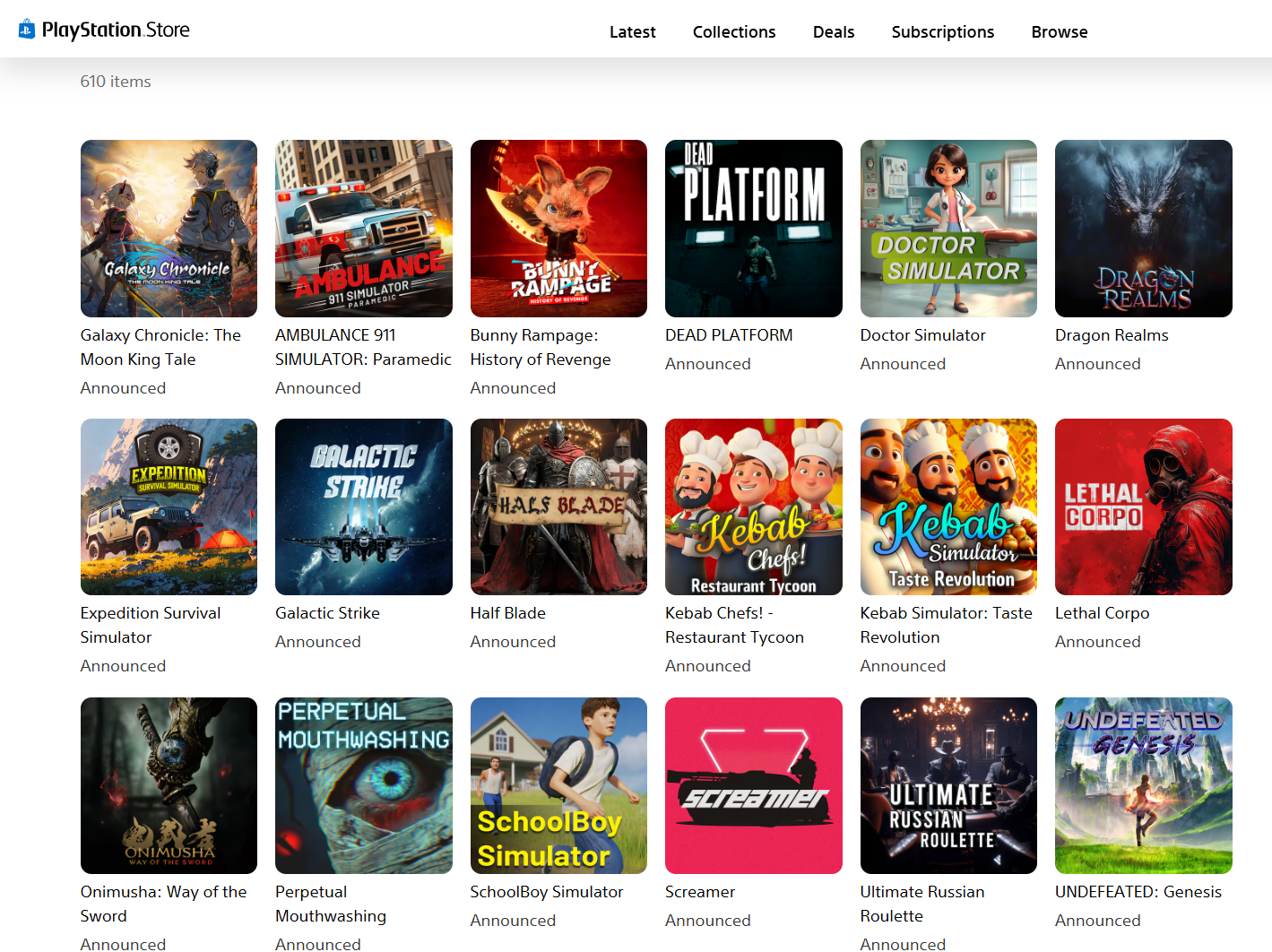
The PlayStation Store and Nintendo eShop are experiencing an influx of low-quality games, often described as "slop," raising concerns among users. These games frequently utilize generative AI for misleading store page assets, often mimicking popular titles or employing hyper-stylized visuals that don't reflect the actual gameplay. This issue, initially prominent on the eShop, has recently spread to the PlayStation Store, particularly affecting the "Games to Wishlist" section.
The problem isn't merely the presence of "bad" games, but the sheer volume of similar, low-effort titles overwhelming the stores. These games, often simulation titles perpetually on sale, are frequently produced by a small number of difficult-to-trace companies, sometimes even changing names to avoid accountability. This has led to complaints about the eShop's performance, which is reportedly slowing down due to the increased number of games.
To understand this phenomenon, the article investigates the game release process across major storefronts (Steam, Xbox, PlayStation, and Nintendo Switch). Interviews with eight anonymous game developers and publishers reveal insights into the certification process ("cert"). While all platforms have technical requirements, the level of scrutiny varies. Steam and Xbox publicly document their requirements, while Nintendo and Sony do not. Cert primarily focuses on technical compliance and legal adherence, not quality assurance. Store page reviews are mainly for consistency and language accuracy, with less emphasis on the accuracy of the game's representation. While some platforms review page changes before launch, others do minimal post-launch checks. Notably, none of the console storefronts have specific rules against generative AI use in game assets or store pages, although Steam requests disclosure.
The article suggests several reasons for the disparity in "slop" across platforms. Microsoft's game-by-game vetting process, unlike the developer-based approach of Nintendo, Sony, and Valve, makes it less susceptible to this issue. Nintendo's approval process, described as the "easiest to scam," allows for a rapid influx of low-quality games. Some developers exploit the system by repeatedly releasing bundles with minimal changes to maintain top placement in "New Releases" and "Discounts" sections. PlayStation's "Games to Wishlist" sorting by release date exacerbates the problem, surfacing numerous low-quality games with distant release dates. Steam, while not immune, has better search and filtering options, and its high volume of releases dilutes the impact of individual low-quality games.
While users demand stricter regulation, developers express concerns about accidentally targeting quality games. The experience of "Better eShop," a user-created filter, highlights the difficulty of accurately identifying and removing low-quality content without harming legitimate games. The article concludes that while platform holders may not intentionally allow "junk AI" games, the sheer volume of submissions makes it difficult for human reviewers to effectively filter out low-quality content. The challenge lies in balancing the need to prevent the influx of low-effort games with the risk of accidentally penalizing legitimate developers.

Latest Articles
Konami Livestream: Metal Gear Solid Delta, Silent Hill f Details Revealed This Week
Play I'm particularly hopeful that Konami’s mention of "and more" will include No Code’s Silent Hill Townfall. It’s been years since we’ve received meaningful updates, and I’m eager to learn more. I’m also still waiting for news on future remakes or
Black Ops 7 Rating Hints at Premium Content Continuation
Call of Duty fans think they've found evidence suggesting that Call of Duty: Black Ops 7 will let players transfer their cosmetic skins from Black Ops 6.The ESRB rating has confirmed Black Ops 7 will be rated M for Mature 17+ and release on PC, PS5,

My Little Pomodoro Boosts Focus, Hits Android
Most productivity timers demand your focus. Devfloor's new release, My Little Pomodoro: Focus, actually gives something in return. This charming Android app transforms concentration into a rewarding experience rather than a tedious obligation.Underst
Tekken 8 Director Slams Fan Over Anna Williams' New Look: 'Unconstructive and Pointless'
Play
Tekken 8 veteran Anna Williams is making her return to the roster, and while her redesigned look has been well received by the majority of fans, it has also sparked some debate—particularly over comparisons of her new outfit to Santa Claus.
When a fan asked Tekken game director and chief prod
Ready or Not Shares Update in Censorship and Review-Bomb Fight
VOID Interactive has responded to player criticism following updates to the PC version of its controversial shooter Ready or Not, implemented to secure its console release. The studio clarified there have been "misconceptions and misinformation" rega

Colors of Life: 365 New Mobile Puzzles Annually
Colors of Life is an Android game that offers a fresh take on coloring. As the name suggests, you fill in colors, combining classic color-by-number mechanics with pixel art style. Developed by Rursus, it’s free to play with optional extras available
Latest Games

Dreamweavers Curse
Casual丨470.30M

Euro Train Simulator 2
Simulation丨124.55M



Stenciletto
Educational丨107.65MB


Game Vault:Slots Game
Card丨46.10M

Just Dance Now
Music丨127.48MB

Boarding School
Casual丨190.30M









Top News
MORE +


01
01-07
BREAKING: Flight Simulator 2024 Login Woes Ground Players
Flight Simulator 2024 Launch Plagued by Technical Difficulties
The highly anticipated launch of Flight Simulator 2024 has been significantly hampered by widespread technical problems, leaving many players grounded before they could even take to the virtual skies. This article details the reported d
02
01-06
CDPR acknowledged weak gameplay in The Witcher 3
The Witcher 3, while critically acclaimed, wasn't without its flaws. Many fans felt the combat system fell short.
In a recent interview, Witcher 4's game director, Sebastian Kalemba, acknowledged weaknesses in the previous game's gameplay, specifically highlighting the need for significant improvem
03
11-17
Hogwarts Legacy 2 is "One of the Biggest Priorities" for WB Games
Following the successful launch of Quidditch Champions this week, Warner Bros. Discovery has confirmed its plans for a sequel to last year's Harry Potter-based action RPG hit Hogwarts Legacy—2023's best-selling game.Hogwarts Legacy Sequel Plans Confirmed by Warner Bros. DiscoveryExpected in
04
11-16
Airplane Chefs Brings The Ultimate Snack, Pringles, On Board!
Buckle up for some snacks as Nordcurrent has just dropped an exciting event for their cooking game. It’s the most unexpected collab of Airplane Chefs and Pringles. If you’ve been enjoying your virtual life as a flight attendant, things are about to get a lot tastier.The game developer behind p
05
11-16
Play Together to collaborate with Sanrio and introduce new My Melody and Kuromi content
Play Together is bringing back its Sanrio collab with the appearance of My Melody and KuromiYou can collect coins by completing their themed missions that can then be used to draw exclusive itemsAs a bonus there's also new summer-themed content and events, including a major bug huntPlay Together, th
Topics
More +