
Nvidia GeForce RTX 5090 Founders Edition Review
Author : Sadie
Mar 16,2025
Every couple of years, Nvidia unveils a powerhouse graphics card, pushing PC gaming into a new era. The Nvidia GeForce RTX 5090 is no exception, though its approach to next-generation performance is unique. In many games, the performance boost over the RTX 4090 isn't as dramatic as expected—at least without DLSS Frame Generation. However, the next generation of Nvidia's DLSS, for both upscaling and frame generation, delivers remarkable leaps in image quality and performance, surpassing typical generational improvements.
The RTX 5090's upgrade value depends on your gaming habits: the games you play, your monitor's resolution and refresh rate, and your acceptance of AI-generated frames. For those with sub-4K, sub-240Hz displays, this upgrade might not be worthwhile. But for high-end display owners, the AI-generated frames offer a glimpse into the future of gaming.
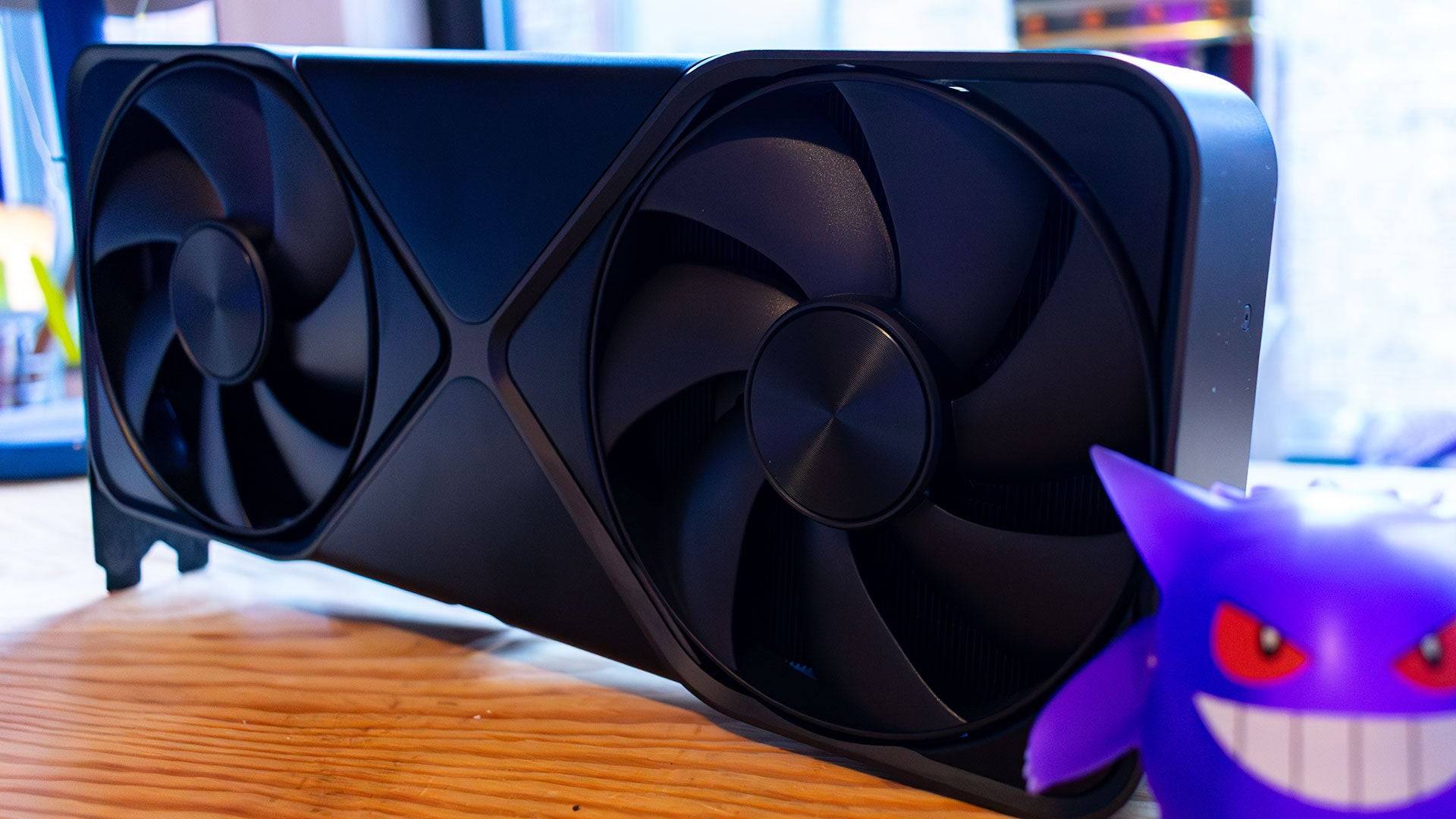
Nvidia GeForce RTX 5090 – Photos




RTX 5090 – Specs and Features
The Nvidia GeForce RTX 5090 leverages Blackwell, Nvidia's high-end architecture powering data centers and supercomputers behind popular AI models. This hints at the RTX 5090's strengths, but Nvidia hasn't neglected non-AI aspects.
The 5090 packs more Streaming Multiprocessors (SMs) into the same number of Graphics Processing Clusters (GPCs), resulting in 21,760 CUDA cores (up from 16,384 in the RTX 4090)—a 32% increase contributing significantly to raw gaming performance. Each SM retains four Tensor Cores and one RT Core, yielding 680 Tensor Cores and 170 RT cores (compared to 512 and 128 in the RTX 4090). The 5th-generation Tensor Cores, supporting FP4 operations, enhance AI performance and reduce VRAM dependency.
This powerful silicon is paired with 32GB of GDDR7 VRAM, a generational leap from the RTX 4090's GDDR6X, offering speed and power efficiency improvements. However, the 5090's 575W power requirement (a significant increase over the 4090) prioritizes performance over extreme power efficiency.
The enhanced efficiency of the new Tensor Cores enabled Nvidia to shift the DLSS algorithm to a Transformer Neural Network (TNN) from a Convolutional Neural Network (CNN). While not necessarily boosting frame rates with DLSS enabled, Nvidia claims improved image quality and reduced artifacts.
Beyond the internal DLSS changes, Nvidia introduces Multi-Frame Generation. This refined version of the RTX 4090's Frame Gen technology is more efficient and smoother, generating multiple frames from each rendered image. This drastically improves frame rates but, like its predecessor, should only be enabled with already decent frame rates.
Purchasing Guide
The Nvidia GeForce RTX 5090 launched January 30th, starting at $1,999 (Founders Edition). Third-party cards can be considerably more expensive.
The Founders Edition
The RTX 5090's 575W power draw (much higher than the RTX 4090's 450W) necessitates robust cooling. While expecting a larger card than the RTX 4090, Nvidia surprisingly created a smaller, dual-slot design with dual fans.
During testing (including standard benchmarks and DLSS 4 with multi-frame generation), temperatures peaked around 86°C at 578W power consumption. While high (higher than the RTX 4090's 80°C), it remained below throttling levels.
Nvidia achieved this compact design by centrally positioning a smaller PCB, with fans on either side and a heatsink spanning the card's width. Air intake is from the bottom, exhausted through the top. Unlike previous generations, there are no exhaust vents under the rear output ports.
The design maintains a similar aesthetic to previous generations, featuring a silver 'X' and a 'GeForce RTX' logo with white LEDs.
The power connector, while resembling the 12VHPWR connector, is a new 12V-2x6 connector, supposedly more efficient. Nvidia includes a 12V-2x6 adapter requiring four 8-pin PCIe power connectors. The angled connector on the card improves cable connection.
This design allows for smaller PC builds, unlike previous generations. However, third-party designs will likely be larger.
DLSS 4: Fake Frames?
Nvidia claims up to 8x performance boosts with the RTX 5090. While not reaching that level, the RTX 5090 achieves extremely high frame rates in demanding games, largely due to frame generation. While raw rasterization performance improves, the true next-gen benefit lies in AI-generated frames.
DLSS 4's Multi-Frame Generation builds upon DLSS 3 Frame Generation, but with a new AI Management Processor (AMP) core. The AMP efficiently assigns tasks across the GPU, traditionally handled by the CPU.
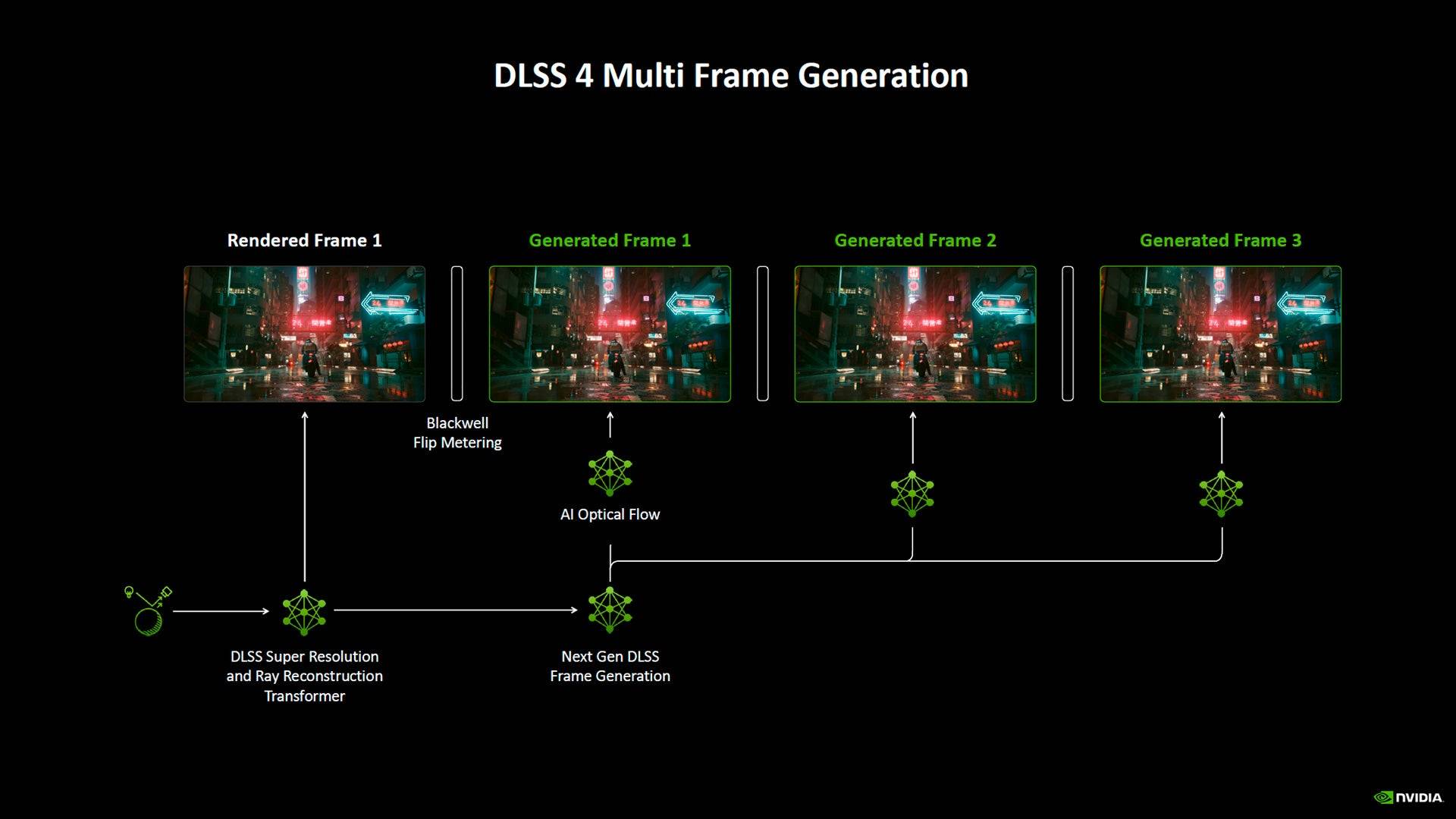
Nvidia states the AMP and 5th-generation Tensor Cores create a 40% faster frame generation model requiring 30% less memory. This model generates 3 AI frames per rendered frame, with a Flip Metering algorithm mitigating latency. Nvidia claims this is why multi-frame generation doesn't work on RTX 4000 cards due to CPU-based frame pacing.
Like previous generations, enabling this feature requires a decent baseline frame rate (around 60fps). Lower frame rates can cause significant latency. It pairs best with DLSS upscaling.
At launch, DLSS 4 supports numerous games already compatible with DLSS 3 Frame Generation. Testing on beta builds of Cyberpunk 2077 and Star Wars Outlaws showed impressive results.
In Cyberpunk 2077 at 4K with Ray Tracing Overdrive and DLSS Performance, the RTX 5090 achieved 94 fps. With DLSS 2x frame generation, this increased to 162 fps, and with 4x frame generation to 286 fps (exceeding the display's capabilities). Star Wars Outlaws showed similar results, reaching around 300 fps with DLSS 4.
Multi-Frame Generation proved effective, with minimal artifacts observed. However, high-end 4K displays are needed to fully benefit. Further testing across more games is needed.
RTX 5090 – Performance
The RTX 5090 is incredibly powerful, but testing revealed complexities. 3DMark showed generational improvements over the RTX 4090. However, in most games, the RTX 5090 was CPU-bottlenecked, even at 4K, using a Ryzen 7 9800X3D CPU. For many with high-end graphics cards, this $1999 upgrade might not be transformative. It's an investment in future games.
DLSS 4 was disabled in comparative benchmarks. Nvidia cards used driver version 566.36, AMD cards used AMD Adrenalin 24.12.1. Games were tested on their latest public builds.
Test System:
- CPU: AMD Ryzen 7 9800X3D
- Motherboard: Asus ROG Crosshair X870E Hero
- RAM: 32GB G.Skill Trident Z5 Neo @ 6,000MHz
- SSD: 4TB Samsung 990 Pro
- CPU Cooler: Asus ROG Ryujin III 360
In 3DMark, the RTX 5090 was up to 42% faster than the RTX 4090 (Speed Way: 14,399 vs 10,130; Port Royal: 36,946 vs 25,997). Compared to the RTX 3090, the improvement was 2.5x.
Call of Duty Black Ops 6 showed CPU bottlenecking at 4K Extreme settings with DLSS Performance (161 fps vs RTX 4090's 146 fps—a 10% difference). Compared to the RTX 3090 (91 fps), it was nearly a 2x improvement.
Cyberpunk 2077 also showed CPU bottlenecking at 4K with Ray Tracing Ultra and DLSS Performance (125 fps vs RTX 4090's 112 fps—10% difference).
Metro Exodus: Enhanced Edition (tested without DLSS) at 4K Extreme showed a 25% improvement over the RTX 4090 (95 fps vs 76 fps).
Red Dead Redemption 2 at 4K maxed out with DLSS Performance showed a 6% improvement over the RTX 4090 (167 fps vs 151 fps).
Total War: Warhammer 3 (no ray tracing or upscaling) showed a 35% improvement over the RTX 4090 (147 fps vs 107 fps).
Assassin's Creed Mirage showed unusually low and spiky performance, possibly a driver issue.
Nvidia GeForce RTX 5090 – Benchmarks


Black Myth: Wukong at 4K Cinematic with DLSS 40% showed a 20% improvement over the RTX 4090 (104 fps vs 84 fps).
Forza Horizon 5 showed minimal difference (216 fps vs 210 fps).
The RTX 5090 is currently the fastest consumer graphics card, but many games don't fully utilize its power. This will likely change over time. The RTX 4090 remains sufficient for many.
The RTX 5090's success hinges on the future of AI-powered gaming. DLSS 4 significantly boosts frame rates, but requires a high-end setup. It's a cutting-edge investment for those willing to bet on an AI-driven future. For others, the RTX 4090 is a powerful option.
Latest Articles

Goblin Valley: Cozy Home Game Opens Pre-Registration
Build and expand your thriving goblin farm villageInteract with quirky goblins, each with unique personalitiesMonitor and fulfill your goblin residents' needsUnimob Global has recently launched pre-registrations for Idle Goblin Valley: Chill Farm, of

Heartopia is kicking off its first closed beta test next month
The initial CBT runs from November 4th through the 18thEngage in hobbies such as fishing, birdwatching, and cookingAdopt pets, customize your home interior, and design unique outfitsHeartopia, XD Games’ highly anticipated life simulation title announ
Summoners War set to host collaboration with the iconic fantasy book series The Lord of the Rings
Summoners War: Sky Arena has teamed up with none other than The Lord of the Rings.
Set to launch later this month, the collaboration brings iconic characters from the Fellowship and beyond into the game.
The Lord of the Rings needs no introduction—it

Another Eden expands its Chrono Cross collaboration content with Glenn and new story
Another Eden is introducing fresh content to its existing Chrono Cross collaboration materialThe release includes a beloved character named Glenn from The Cursed DragoonA new character and upcoming events are also being added to honor Japan Cat DayAl

The $13 FrSara Portable Neck Fan Is an Inexpensive Solution to Beating the Summer Heat
Summer has arrived, and neck fans are seeing a surge in popularity. These portable fans offer a simple, effective, and affordable way to stay cool and comfortable. Amazon is currently offering 50% off the FrSara Rechargeable Portable Neck Fan with th
Hand-Drawn Photography Adventure Game TOEM Opens Pre-Registration on Mobile
BAFTA-winning title TOEM: A Photo Adventure arrives on mobile devices worldwide.
Developed by Swedish indie studio Something We Made, pre-registration for TOEM is now available on Android. The official release date is set for October 22nd.
Fun fact:
Latest Games
2114 LADA Russian Streets Drag
Racing丨122.9 MB
Chiron Bugatti Supercar Extra
Racing丨96.6 MB
Lada 2110 Special Unit Race
Racing丨124.3 MB

المهجول: هجولة ودرفت
Racing丨468.3 MB

Arclight City
Role Playing丨8.2 MB

Temple of Endless Night
Role Playing丨10.8 MB
BattleMass
Role Playing丨113.2 MB










Top News
MORE +

01
01-06
CDPR acknowledged weak gameplay in The Witcher 3
The Witcher 3, while critically acclaimed, wasn't without its flaws. Many fans felt the combat system fell short.
In a recent interview, Witcher 4's game director, Sebastian Kalemba, acknowledged weaknesses in the previous game's gameplay, specifically highlighting the need for significant improvem
02
01-07
BREAKING: Flight Simulator 2024 Login Woes Ground Players
Flight Simulator 2024 Launch Plagued by Technical Difficulties
The highly anticipated launch of Flight Simulator 2024 has been significantly hampered by widespread technical problems, leaving many players grounded before they could even take to the virtual skies. This article details the reported d
03
11-17
Hogwarts Legacy 2 is "One of the Biggest Priorities" for WB Games
Following the successful launch of Quidditch Champions this week, Warner Bros. Discovery has confirmed its plans for a sequel to last year's Harry Potter-based action RPG hit Hogwarts Legacy—2023's best-selling game.Hogwarts Legacy Sequel Plans Confirmed by Warner Bros. DiscoveryExpected in
04
11-16
Airplane Chefs Brings The Ultimate Snack, Pringles, On Board!
Buckle up for some snacks as Nordcurrent has just dropped an exciting event for their cooking game. It’s the most unexpected collab of Airplane Chefs and Pringles. If you’ve been enjoying your virtual life as a flight attendant, things are about to get a lot tastier.The game developer behind p
05
11-16
Play Together to collaborate with Sanrio and introduce new My Melody and Kuromi content
Play Together is bringing back its Sanrio collab with the appearance of My Melody and KuromiYou can collect coins by completing their themed missions that can then be used to draw exclusive itemsAs a bonus there's also new summer-themed content and events, including a major bug huntPlay Together, th
Topics
More +